





Multifunction calibrators

Measure • Generate • Simulate

Check every process signal, in the field and in the laboratory

TEST-4, MSC and MSC-D measure and generate voltage, current, thermocouple, RTD, load-cell and frequency signals. Ideal for plant maintenance, control-panel testing and measurement quality assurance.

Find your calibrator Request a quotation

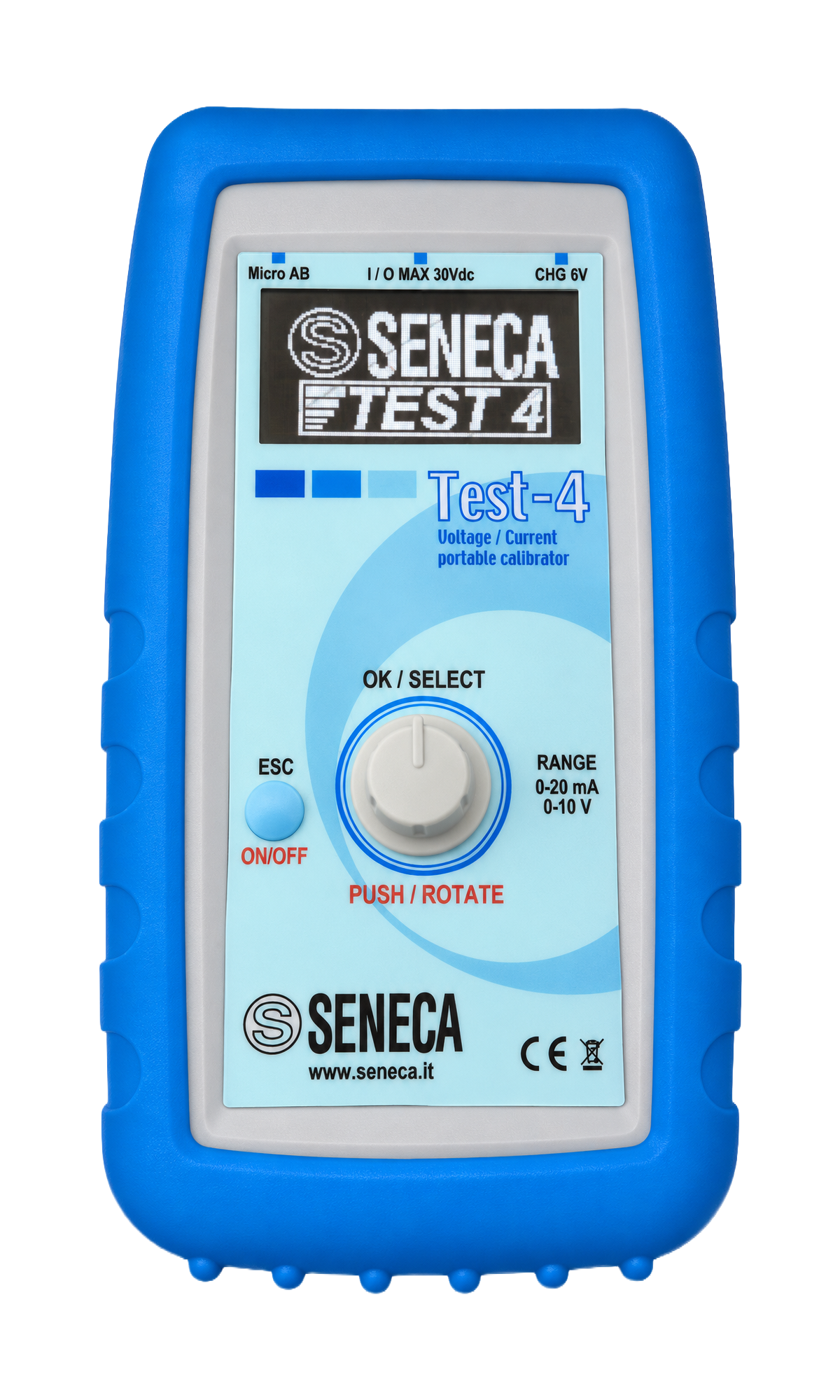
SENECA TEST-4TEST-4

SENECA MSC-DMSC-D

SENECA MSCMSC

Measure • Source • Simulate

SENECA

3

models: TEST-4, MSC and MSC-D

0,03%

baseline accuracy of MSC and MSC-D

9

ramp segments, single or continuous cycle

100.000

values logged and exportable to CSV

Loop 4–20 mA 4 mA = 0% • 12 mA = 50% • 20 mA = 100% of measurement span

01 The range 02 Selection guide 03 Functions 04 Applications 05 Technical data 06 Calibration and accessories 07 FAQ

01 The range

Three calibrators, from a handheld instrument to the test bench

The same philosophy, three levels of functionality: TEST-4 for voltage and current signals; MSC and MSC-D for all process signals, controlled via an app or a touchscreen and network connection.

SENECA TEST-4

V / mA signals

TEST-4

Portable signal generator and meter for analog voltage and current signals, with ramp function. Ideal for checking PLC inputs, controllers and data acquisition systems.

0…11 V • 0…21 mA active and passive • 0.1% accuracy

Field use

  • Low-power OLED display and multifunction rotary encoder
  • Multilingual menu, non-slip housing
  • Ø 2 mm test leads

Functions

  • Rising and falling voltage and current ramps
  • 1 µA / 1 mV resolution
  • Modbus RTU control via USB

At a glance

Quantities Voltage and current

Modes Measurement and generation, V / mA ramps

Operating ranges 0…11 V • 0…21 mA active and passive

Accuracy 0,1%

Key features Encoder and OLED display, Modbus RTU over USB

Power and battery life 2 × AA NiMH • at least 8 h

TEST-4 product page

SENECA MSC

App controlled

MSC

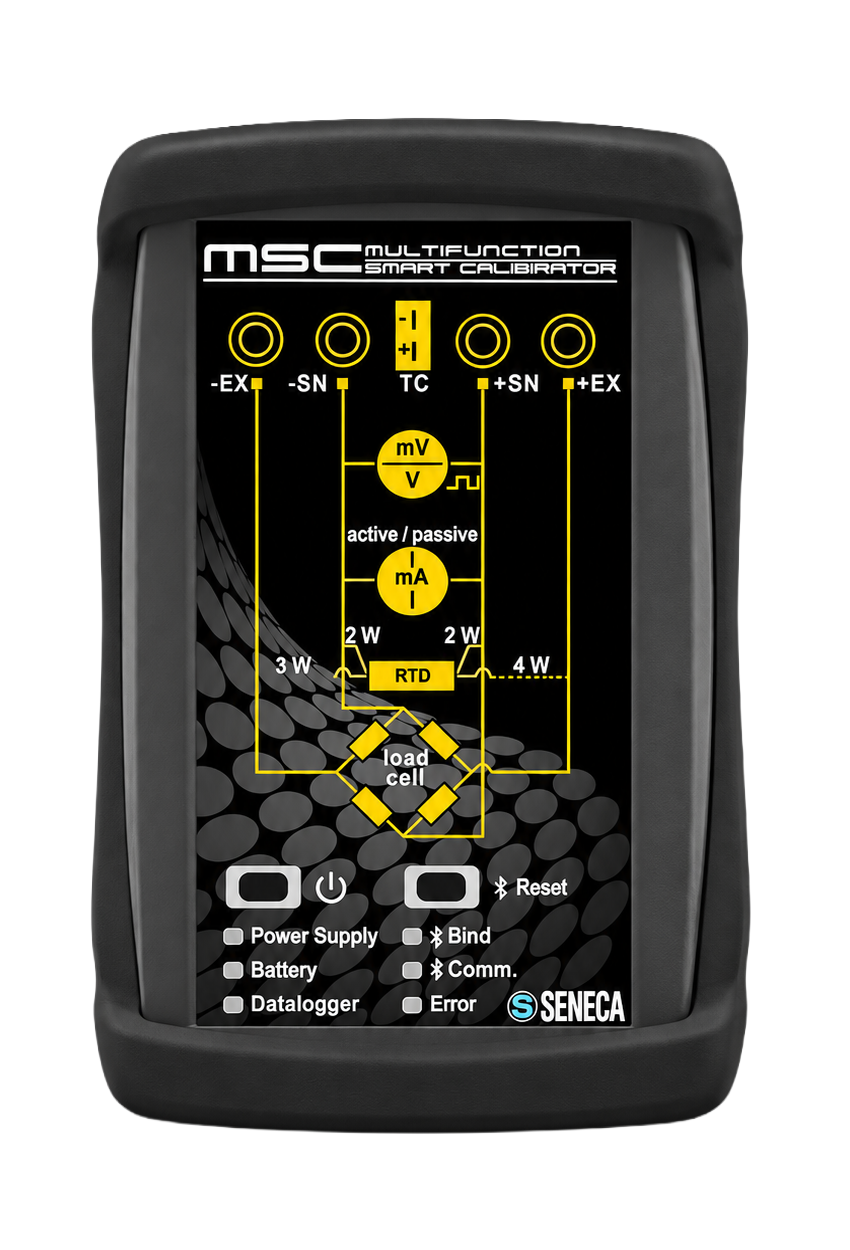
Multifunction Bluetooth calibrator: measures and generates all process signals, controlled from a smartphone, tablet or PC. Can be integrated with LabVIEW.

V • mV • mA • TC • RTD • load cells • Hz / pulses • 0.03% accuracy

Control

  • MSC BY SENECA app for iOS and Android
  • Bluetooth Low Energy 4.1
  • MSC DESKTOP software for Windows and LabVIEW driver

Functions

  • Ramps with up to 9 segments on all signals
  • Data logger for up to 100,000 values, CSV export
  • Four Ø 4 mm sockets and miniature thermocouple connector

At a glance

Quantities V, mV, mA, TC, RTD, load cells, Hz / pulses

Modes Measurement, generation and sensor simulation, ramps for all signals

Operating ranges 0…26 V • −10…+90 mV • 0…24 mA • 0,1…1.000 Hz

Accuracy 0.03% baseline; 0.04% current

Key features Bluetooth app, LabVIEW, data logger for 100,000 values

Power and battery life 3,400 mAh LiPo • at least 8 h • USB charging

MSC product page

SENECA MSC-D

New

MSC-D

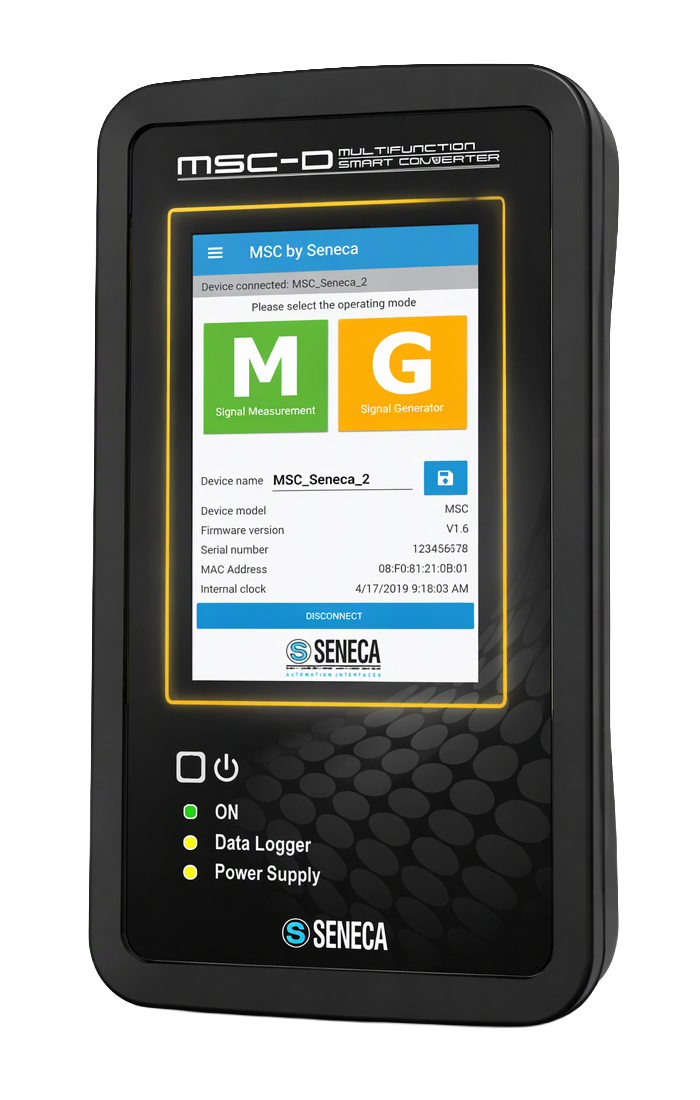
Multifunction calibrator with color touchscreen, Ethernet and Wi-Fi. Works independently in the field or remotely via web server or Modbus TCP, including integration into automated test benches.

V • mV • mA • TC • RTD • load cells • Hz / pulses • 0.03% accuracy

Interfaces

  • 3.5″ TFT touchscreen, 320 × 480
  • 100 Mbit/s Ethernet and 2.4 GHz Wi-Fi (Access Point or Station)
  • Integrated web server, no software installation required

Automated testing

  • Modbus TCP/IP server for up to 8 clients
  • Automatic startup on power-up
  • Saved ramps and presets, CSV data logger

At a glance

Quantities V, mV, mA, TC, RTD, load cells, Hz / pulses

Modes Measurement, generation and sensor simulation, ramps for all signals

Operating ranges 0…26 V • −10…+90 mV • 0…24 mA • 0,1…1.000 Hz

Accuracy 0.03% baseline; 0.04% current

Key features 3.5″ touchscreen, Ethernet and Wi-Fi, web server, Modbus TCP for up to 8 clients

Power and battery life 3,400 mAh LiPo • at least 4 h • USB charging

MSC-D product page

02 Selection guide

Which calibrator do you need?

Select the signals and features you need: the guide highlights the models that meet all your requirements and shows what the others lack.

TEST-4: voltage and current with ramps. MSC: all signals, Bluetooth app control, LabVIEW. MSC-D: all signals, touchscreen, Ethernet, Wi-Fi and Modbus TCP.

03 Functions

One instrument to measure, generate and document

Programmable ramps

Up to 9 segments in single or continuous cycles, minimum duration 1 s: simulate controlled variations to test thresholds, alarms and control loops.

Data logging

MSC and MSC-D store up to 100,000 values and export them as CSV files to document completed checks.

Three control methods

Rotary encoder and local menu on TEST-4, smartphone and tablet app for MSC, touchscreen and browser for MSC-D.

Test-bench integration

Modbus TCP/IP over Ethernet and Wi-Fi for MSC-D, LabVIEW driver and Modbus via USB for MSC, Modbus RTU via USB for TEST-4.

Ready for field use

Rechargeable battery power, electrically isolated instrument, carrying case and test-lead sets as accessories.

04 Applications

Three typical tests, step by step

01

Checking a 4–20 mA loop

TEST-4 • MSC • MSC-D

Calibrator 4 / 12 / 20 mA generation

PLC input Passive analog

Supervision Process value

The calibrator replaces the transmitter and powers the loop: check scaling, readings and thresholds along the entire signal chain.

02

RTD and thermocouple simulation

MSC • MSC-D

Calibrator Pt100 or type K thermocouple

Transmitter RTD / TC input, 4–20 mA output

PLC / HMI Displayed temperature

Set known temperatures and compare the downstream reading. Configure the same sensor and range on every device.

03

Checking a weighing system

MSC • MSC-D

Calibrator 350 Ω bridge simulation in mV/V

Weight indicator Load-cell input

PLC / HMI Acquired weight

Simulate load points to verify zero, full scale and acquisition response. The test concerns the electronics, not the mechanical parts of the scale.

Terminal connections and operating configurations are described in each model's manual.

05 Technical data

Model comparison

Feature TEST-4 MSC MSC-D
Primary function V / mA signal calibrator App-controlled multifunction calibrator Multifunction calibrator with touchscreen
Accuracy 0,10% 0.03% baseline; 0.04% current 0.03% baseline; 0.04% current
Voltage 0…11 V 0…26 V; −10…+90 mV 0…26 V; −10…+90 mV
Active / passive current 0…21 mA 0…24 mA 0…24 mA
Thermocouples — J, K, T, E, N, R, S, B, L J, K, T, E, N, R, S, B, L
RTDs — 7 types; 2/3/4-wire measurement 7 types; 2/3/4-wire measurement
Load cells — 350 Ω bridge 350 Ω bridge
Frequency / pulses — 0,1…1.000 Hz 0,1…1.000 Hz
Ramps Voltage and current All signals, up to 9 segments All signals, up to 9 segments
Datalogger — 100,000 values, CSV, interval > 500 ms 100,000 values, CSV, minimum interval 1 s
Interface OLED 128 × 64, encoder iOS / Android app, Windows software TFT 3.5″ touchscreen, browser
Communication USB, Modbus RTU Bluetooth LE 4.1, Micro USB, LabVIEW Ethernet, Wi-Fi, Modbus TCP/IP
Battery / minimum runtime 2 × AA NiMH / 8 h LiPo 3.400 mAh / 8 h LiPo 3.400 mAh / 4 h
Dimensions / weight 75 × 140 × 33 mm / 250 g 88 × 147 × 25 mm / 330 g 96 × 171 × 44 mm / 395 g

MSC and MSC-D measurement ranges

Signal / sensor Range
Pt100 / Pt500 / Pt1000 −200…+850 °C
Cu50 / Cu100 −180…+200 °C
Ni100 / Ni120 −60…+250 °C
Type J thermocouple −210…+1.200 °C
Type K thermocouple −200…+1.372 °C
Type T / E / N thermocouples −200…+400 / +1.000 / +1.300 °C
Type R / S thermocouples −50…+1.768 °C
Type B thermocouple +250…+1.820 °C
Type L thermocouple −200…+800 °C
Load cell, 350 Ω bridge MSC −0,2…+2,4 mV/V; MSC-D 0…+2,4 mV/V

Summary values for selection: additive errors, operating conditions and signal-specific performance are detailed in the manuals. Battery life depends on operating conditions.

06 Calibration and accessories

Documented measurement traceability

Each calibrator can be ordered with an internal SENECA calibration report or an Accredia LAT calibration certificate, accepted in quality audits.

-T

Internal calibration report

Issued by the SENECA laboratory with measurements recorded at the test points.

TEST-4-T • MSC-T • MSC-D-T

-LAT

Accredia LAT certificate

Calibration performed by an accredited center, with traceability to national standards and stated uncertainty.

TEST-4-LAT • MSC-LAT • MSC-D-LAT

PDF Sample calibration report

Ordering codes and accessories

Code Description
TEST-4 V / mA signal generator and meter with ramp simulation
TEST-4-C Carrying and protective case for TEST-4
TEST-4-PK TEST-4 precision kit: test leads and alligator clips
TEST-4-R Precision test-lead set for TEST-4
TEST-4-PWR Power supply for TEST-4
MSC Bluetooth multifunction calibrator
MSC-D Multifunction calibrator with touchscreen
MSC BY SENECA MSC control app
MSC DESKTOP MSC data export and firmware update software
MSC-C Carrying and protective case for MSC and MSC-D
MSC-PK Test-lead set for MSC and MSC-D
MSC-TC-PROBE Type K test thermocouple for MSC and MSC-D

Brochures, manuals and software

Download the multifunction calibrator brochure or open a product page for manuals, firmware and drivers.

Brochure (PDF)

07 FAQ

Frequently asked questions

What is the difference between MSC and MSC-D?

They measure and generate the same signals with the same baseline accuracy. MSC has no display and is operated via a Bluetooth app; MSC-D has a touchscreen and connects via Ethernet and Wi-Fi, with a web server and Modbus TCP for test benches.

Can the calibrator power a 4–20 mA loop?

Yes. All three models generate active current to power a loop connected to a passive input, or passive current when the loop is already powered by the system.

Which RTDs and thermocouples can I simulate?

MSC and MSC-D support thermocouple types J, K, T, E, N, R, S, B and L, and 7 RTD types: Pt100, Pt500, Pt1000, Cu50, Cu100, Ni100 and Ni120. RTDs can be measured with 2, 3 or 4 wires and simulated with 2 wires.

Can MSC-D be used in an automated test bench?

Yes. MSC-D operates as a Modbus TCP/IP server over Ethernet or Wi-Fi for up to 8 clients and can start automatically when powered. The test-bench software sets the signals to be generated and reads measurements via Modbus registers.

What is the difference between an internal calibration report and a LAT certificate?

The internal report documents checks performed by the SENECA laboratory. The LAT Accredia certificate is issued by an accredited center and ensures traceability to national standards; it is required when the quality system specifies accredited calibration.

How do I export recorded data?

MSC and MSC-D store up to 100,000 values in CSV format. On MSC, data is downloaded via the app or MSC DESKTOP software; on MSC-D, directly via the web server.

Choose the right calibrator for your tests

SENECA S.r.l. • Via Austria, 26 • 35127 Padova (I) • Tel. +39 049 87.05.359

Request a quotation MSC product page MSC-D product page

loading results