

 ES
ES






ADAPTIVE AUTOMATION
The SENECA Paradigm of Human-Centric, Interoperable, and Secure Automation
In recent years, industrial automation has been enriched by new technologies—IIoT, remote assistance, edge computing, cybersecurity, and cloud integration—but this evolution has also led to increasing architectural complexity. Many plants now house gateways, PLCs, industrial routers, and data loggers that have been added over time to meet specific needs.
The Adaptive Automation paradigm, developed by SENECA, proposes a different approach: rather than increasing the number of devices in the field, it integrates multiple functions into a single, scalable platform. When requirements change, the hardware is not replaced; instead, the configuration is updated, making the automation more flexible and adaptable over time.
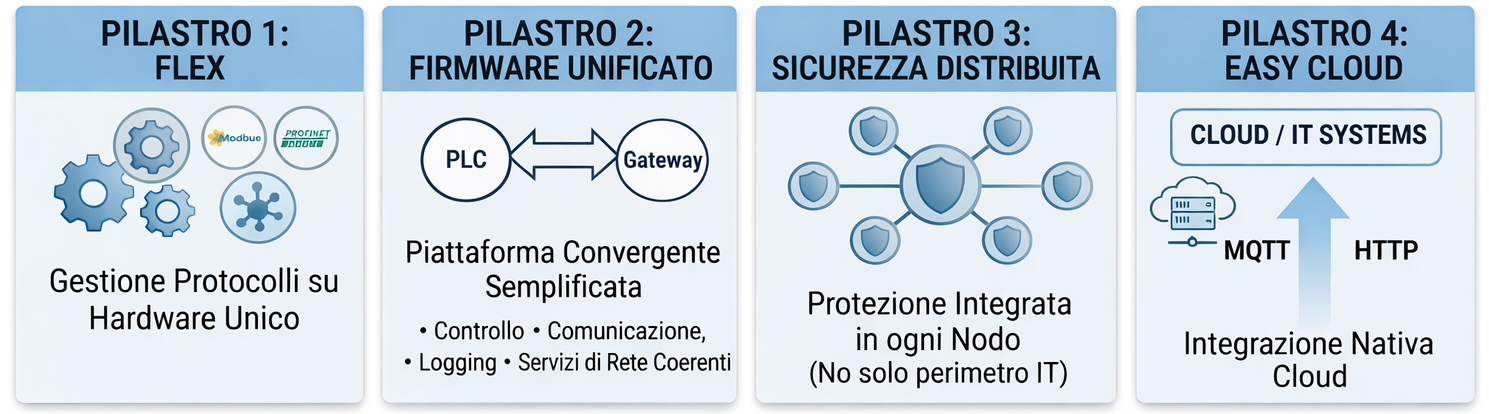
The Four Pillars of Architecture
Il paradigma Adaptive Automation si basa su quattro elementi tecnologici integrati: FLEX, Firmware Unificato, Sicurezza Distribuita ed Easy Cloud.
Operational benefits
- Reduced complexity: fewer devices, cables, and points of failure.
- Greater energy and operational efficiency.
- Longer system lifecycle thanks to software-based upgrades.
- Greater operational resilience and adaptability to new protocols and systems.
- Automation as an evolutionary platform, configurable and integrated.
Further Reading and Resources